
Most of us think that someone can’t get a Dubai mortgage with existing loans; however, what we don’t know is that there are a lot of people who already have some sort of existing loans or credit card balance along with the mortgage. Even banks are well aware of these loans, but the more important thing is how much you owe and how it affects your overall borrowing capacity.
In this guide, we are going to understand how the UAE evaluates the profile of an individual with existing loans, what role the credit card plays, and what you can do to improve your profile.
How do Banks view Existing loans or credit card debt in Dubai?
Along with your income, the bank also assesses your whole profile; it looks at how much debt you have, the credit card balance, or any other recurring payments that get deducted on a fixed basis. Instead of just your income, it looks at the wider picture and finds out how many financial obligations you have at the moment; that includes all the debt and outstanding payments.
When you apply for a mortgage with existing loans in Dubai, the first step that is taken by the bank is that they combine your whole credit history through the AECB credit report (Al Etihad Credit Bureau), which means organizing and consolidating your financial data, such as all the loans and credit you’ve taken till now, how you’ve repaid them, if you missed any payments or had any late payments, and the amount you’ve repaid.
Types of Debts that Affect Mortgage Applications
- Car loans
- Personal loans—Any kind of loan that’s active and is deducted over a fixed time period.
- Credit Card balances—Even if you pay the full amount monthly, the
- Other mortgages
What is the debt burden ratio, and why does it matter?
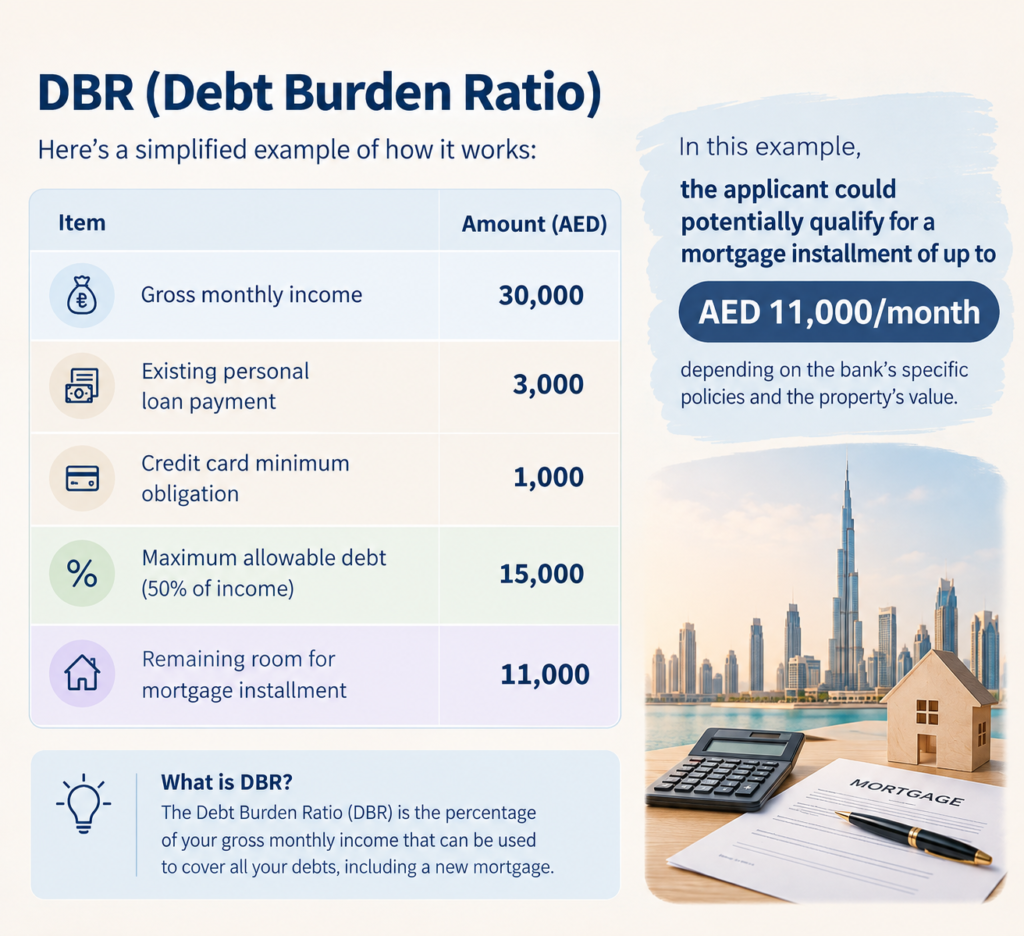
The debt burden ratio is the most important factor considered by UAE banks and a very necessary step in the mortgage process. It refers to the percentage of your income that goes towards debt payments.
Generally, the ratio of your loans and credit cards and the amount of mortgage you’ve proposed should not exceed 50% of your income. However, in some banks there are also some internal thresholds as well, but normally most banks adhere to this 50% rule.
How to Calculate Your DBR
Calculating your debt burden ratio beforehand can be quite helpful. It can help you identify your borrowing capacity and help you set realistic goals in terms of what property you should target. Here’s how you can easily calculate your DBR:
DBR = (Total Monthly Debt Payments ÷ Gross Monthly Income) × 100
Mortgage Eligibility Requirements With Existing Liabilities in the UAE
- Minimum Salary: The criteria for salary are that an individual’s monthly income should be around AED 15,000 to 25,000, depending on the bank. It also varies depending on whether you’re employed or self-employed.
- Employment Stability: In case you’re an employee, you need to have a minimum tenure with the current employer you’re working for, and for people who are self-employed, they would need to have a required trade license and financial statements.
- Age at loan maturity: Banks draft the mortgage terms based on the age of the person taking the loan. Banks usually want their loans to be repaid by the time the applicant reaches 60-70 years of age, so that means older people are given loans for a shorter term period, or the amount of their monthly installments may vary so that they repay the loan by a certain time period. This eventually affects the DBR.
- Residency Status: UAE nationals and non-residents are considered under different terms. Residents of the UAE can take up to 85% of the property value as a loan from the bank by paying only 15% of the amount as a down payment. On the other hand, non-residents can take a maximum of 75% of the value as a loan and are supposed to pay 25% of the property value as a down payment, only on properties that are under the value of 5 million AED; for properties above that value, the down payment percentage increases.
Can Credit Card Debt Alone Block Mortgage Approval?
- Your mortgage approval cannot be decline just because of your credit card debt. Having a credit card, with a balance or not, can alone decide the status of your mortgage approval. Banks usually analyze this on the basis of your credit card limit; they generally consider 5% of that limit as your monthly credit card debt, even if you don’t have a balance.
- That means a credit card with an AED 20,000 limit might be seen as AED 1,000 as monthly liabilities, regardless of your balance. So, high credit limits can reduce your borrowing capacity even if you don’t use it. And in case there are any miss payments or late payments, then that might have a negative effect on your DBR.
How Lenders Verify Your Existing Debt
For every mortgage application, there’s a credit check through AECB. This report gives a clear view of:
- Outstanding balance and all the current loans
- The credit card limits and their average utilization
- Any late or missed payments, or written-off debt
- History of repayment of loans within the UAE.
One of the quickest routes to mortgage approval is a high AECB plus reasonable existing liabilities. Along with the credit report, you generally also need to supply:
- Salary certificate and bank statements (usually for 6 months)
- All outstanding loan liability letters
- Passport copy and Emirates ID
- Audited Financials and Trade License
Tips to Improve Mortgage Approval Chances With Existing Liabilities: High-interest debt
Pay the high-interest credit card balance.
In order to increase your borrowing capacity and improve your chances, pay off your high-interest credit card balance. Paying these down can improve your overall financial position, as well as your credit score, because a high-interest credit card is factor into your DBR and can decrease the capacity of your loan value.
Consult a mortgage advisor.
A professional mortgage consultant can help you present your application in the best way possible. Various banks consider calculations of existing debts, credit card limits, and DBR slightly differently, so a mortgage advisor can help you choose the best lender by analyzing which policy works best for you according to your situation.
Avoid any new debts.
The most important thing you can do is to avoid any new debts at all, because any new debts can reduce your loan capacity and affect your DBR. Any type of loan, credit pay-later, or even a pay-later kind of thing will show up on your credit report and will be add to your liabilities.
Close unused credit cards or reduce limits.
If you have multiple credit cards or a high credit card limit and you don’t need that, then closing all the unnecessary credit cards will be helpful to decrease your debt burden ratio. Reducing the limit of your credit card will also lower the amount that the bank will add to your liabilities.
Combine multiple loans.
Consolidating multiple loans into a single one with the help of a debt consolidation loan. It helps to reduce your debt burden on paper and also make your loans and debts more structured. Combining your several loans or multiple credit cards into one debt can also have an effect on your DBR for a mortgage in Dubai.
Increase the value of the down payment.
One of the ways you can get your mortgage approve is to increase the overall value of your down payment; this automatically reduces the loan value, which results in a decrease monthly installment amount. This is one of the best ways to get your mortgage approve if you cannot do anything regarding your current debts.
How Much Mortgage Can You Afford With Existing Loans?
In order to identify how much mortgage you can afford to have along with the existing loans, you need to do a simple calculation, which is to take 50 percent of your gross monthly income and subtract your current monthly debt payments. What you have left is pretty much the most you could pay toward a mortgage and still get approve—though the actual offer will depend on the lender, the property’s value, and your credit picture.
This calculation can save you a lot of time before you start browsing listings and help you target properties that are actually within your budget. A mortgage adviser can also run bank-specific scenarios, as DBR treatment of credit cards and loans varies slightly between institutions.
FAQs
Can I get a Dubai mortgage with a personal loan?
Yes, you may. The personal loan is treat as an additional debt you have. This will reduce the total amount of mortgage that you can qualify for based on your DBR. If your total commitments are less than 50%, then you should be able to get a mortgage in Dubai. (personal loan + mortgage payments)
Does credit card debt affect mortgage applications?
It does, but not to the degree you might expect. The banks will put a value on your credit card, theoretically equal to the credit limit or the balance you owe. This might reduce the amount of mortgage you qualify for.
What is a good DBR for getting a mortgage in Dubai?
Technically, any DBR less than 50% is acceptable. However, the lower your DBR, the better mortgage rate/terms you will receive. It is always a good idea to apply for a mortgage that has a DBR significantly below (ideally at least 15-20%) 50%.
What happens if I pay off my credit card before I apply for a mortgage?
Yes, in many instances. If you have outstanding credit card balances or high credit limits, your eligible mortgage size will be reduce. Applying for some or all of the balance before you do may improve your eligibility.
How do banks check existing credit commitments?
The banks will ask for a copy of your AECB credit report that shows all the loans you have with the UAE banks and finance companies. We will also verify your credit based on the liability letters and statements you submitted to us when we processed your mortgage application.
Conclusion
You don’t have to be debt-free or have no personal loans to buy a property in Dubai. The important thing is to see where your current liabilities fall in the local salary vs. obligations picture. And more particularly, Debt-to-Income: your Debt-to-Income Ratio. If you know how mortgage eligibility works in Dubai, you’ll stand a better chance of buying that property you’ve always dreamed of.
A qualified mortgage advisor like Karoli Mortgage Consultant can help you get a detailed assessment of what mortgage you qualify for based on your current financial liabilities. Karoli Mortgage specialists will review your financial situation and recommend the most suitable mortgage scheme for you.