
Dubai is one of the top investment destinations for many investors because of factors like transparent property laws, strong rental demand, and high returns that are hard to find in other cities. Dubai’s property market is booming day by day, which is also increasing interest in mortgage-financed investment. If you’re also planning on buying a property in Dubai through a mortgage for investment, then this is the perfect guide for you to know all about calculating real returns, how mortgage financing will help you with the whole process, and all the other factors that you need to know before investing.
Understanding Buying Property in Dubai Through a Mortgage for Investment
Dubai has become one of the top attractions for investors in terms of property buying. A lot of investors want to buy property in Dubai for investment because of reasons like
- Tax-free rental income
- Appealing mortgage rates for both residents and non-residents
- High rental yield
- Increasing rental demand
What does a mortgage-financed property investment mean?
A mortgage-financed property simply means that instead of paying the whole amount of the property that you’re buying in cash at one go and investing all your savings into one asset.
You pay a portion of the amount, approximately 20-25%, and then take the remaining amount from either a bank or a mortgage lender, and then repay them the amount back in an agreed tenure for fixed monthly installments, including both the principal and the interest. The tenure is usually around 15-25 years.
Who Qualifies for a Mortgage in Dubai as an Investor
Before investing in a Dubai property with a mortgage, you also have to check if you’re eligible. Your eligibility depends mainly on some important factors like your family income, residential status, and the type of property that you’re looking for. Mortgage lenders mainly analyze these factors for both UAE residents and non-residents, so you must understand this and also identify where you stand.
1. UAE Residents
If you are a resident of the UAE and self-employed or employed within the country, then you are bound to be eligible according to the standard mortgage terms. The requirement generally includes:
- A monthly income of a minimum of AED 15,000-20,000, depending on the bank.
- UAE employment history of at least 6 months; in the case of self-employed individuals, the time limit of employment history may vary; banks might require a longer employment history.
- If you can pay a down payment of a minimum of 20-25% when buying the property, if the property is higher in price, then the down payment also might be higher than 25%.
2. Non-Residents
Dubai’s property market is also open to non-residents and investors who don’t live in the UAE, and some banks also offer non-resident products; however, the rules and regulations are a bit stricter.
- The down payment required for a non-resident is usually higher. It is usually up to 40-50% of the property value.
- The bank usually asks for proof of stable income in your home country, like salary slips, tax returns, and business financials, to ensure that you can afford to repay the mortgage.
- In comparison to residents of the UAE, the banks participating in mortgages for non-residents are fewer, so the options are limited.
Key Costs to Consider Before Calculating Your Dubai Property Investment ROI
Before concluding your Dubai property investment ROI, do consider some of the factors, which are basically some hidden charges that we tend to overlook or miss when calculating property ROI in Dubai.
Down Payment and Mortgage Payments
The percentage of the down payment is not fixed for everyone and every property. The percentage of the down payment varies according to what property you’re targeting. Instead of the type of property, it also differs a lot based on the basis of your residential status.
Closing Costs and Purchase Expenses
- A 4% charge is given to the Dubai Land Department, payable at the time of registration.
- There’s also a mortgage registration fee, usually around 0.25% of the loan amount, plus a fixed admin fee is also charged by the Dubai Land Department.
- There’s also the bank processing fee that comes to around 0.5-1% of the loan amount.
- Other than this, some other expenses like the agency commission if you’re buying through a real estate broker and legal fees in a few cases.
How to Calculate Rental Yield on a Dubai Property
Once you understand the whole process, the most important step is to calculate your returns on the investment you’re making. Calculating your Dubai property investment ROI is more than just using a single formula.
Step 1: Calculate Gross Rental Yield
The starting point of this whole process is the gross rental yield; this helps to measure the property’s actual potential returns before any type of costs are deducted.
Formula: Gross Rental Yield = (Annual Rental Income ÷ Property Purchase Price) x 100
For example, the annual rental income of the property is 70,000 AED.
The purchase price of the property is 1,400,000.
Then the gross yield will come to 70,000 ÷ 1,400,000 x 100.
= 5%
Step 2: Calculate Net Rental Income (After Expenses)
The next step refers to subtracting all the recurring expenses from your annual rental income to get an overview and an actual idea of what’s actually left at the end.
Formula: Net Rental Income = Annual Rental Income − (Service Charges + Maintenance + Insurance + Vacancy Allowance)
For example, Annual Rent: 100,000
Service charges: AED 8,000
Maintenance reserve: AED 3,000
Insurance: AED 1,500
Vacancy allowance (1 month/year): AED 7,500
Net Rental Income: 100,000 – (8,000+3,000+1,500+7,500)
= 100,000 – 20,000
= 80,000
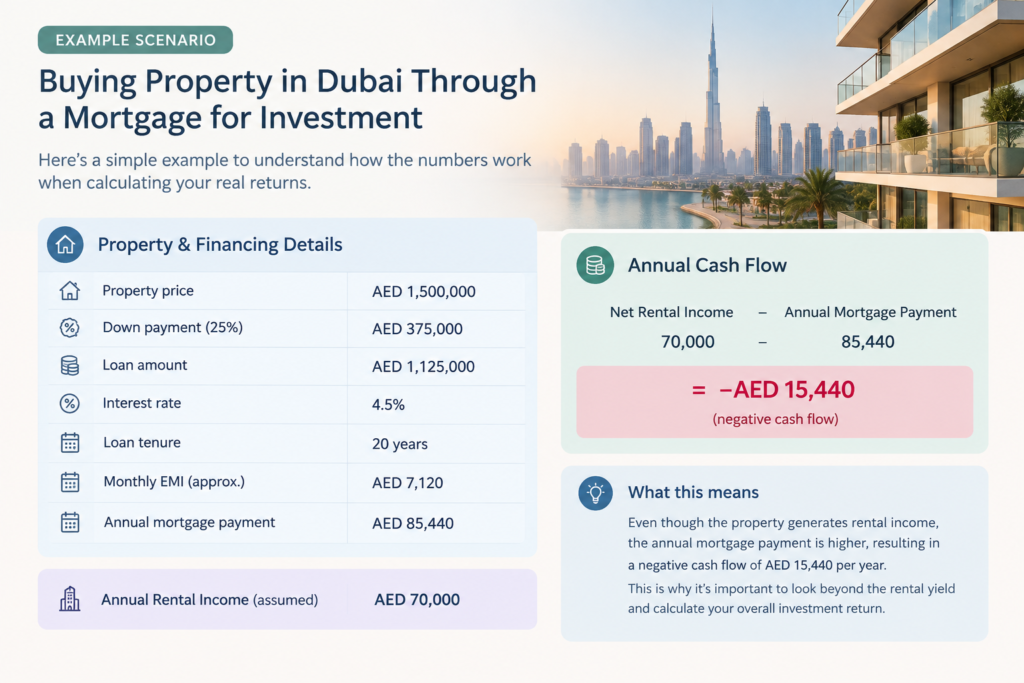
Step 3: Factor in Mortgage Payments for Real Cash Flow
This is the step that factors in the mortgage payments as well and makes it a real cash flow. Subtract your annual mortgage payments (principal + interest) from net rental income to see your actual cash flow.
Step 4: Account for Property Appreciation and Capital Gains
Instead of just rental income, property investors also benefit from capital appreciation, which means the increase in value of their property over time.
Formula:
Capital Gain = ((Future Property Value − Purchase Price) ÷ Purchase Price) x 100
For Example:
The purchase price of your property is: AED 1,500,000.
And the estimated value after 5 years (at 4% average annual appreciation): AED 1,825,000
So the Capital Gain = ((1,825,000 − 1,500,000) ÷ 1,500,000) x 100.
= 21.7% over 5 years
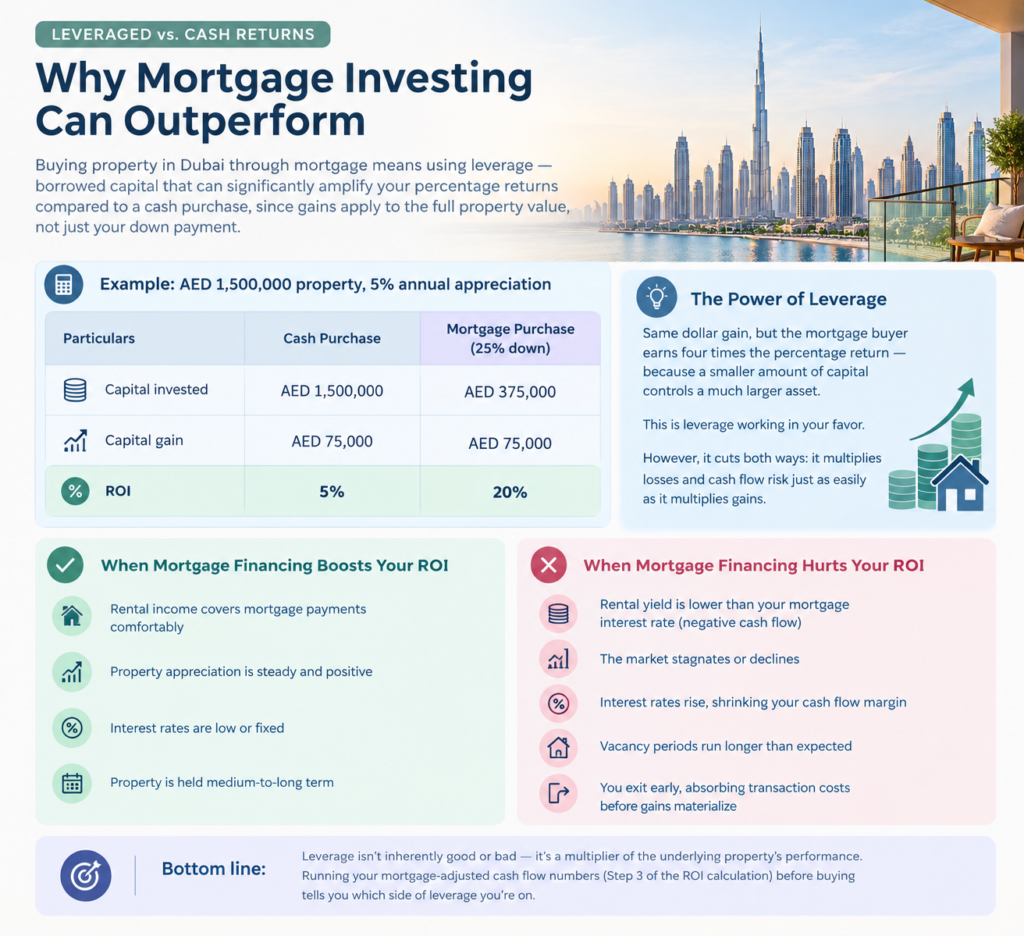
Leveraged vs. Cash Returns—Why Mortgage Investing Can Outperform?
This refers to how we purchase the Dubai property investment with a mortgage; how we decide to pay the capital—cash or borrowed capital—can play a significant role in changing the capital gain. Borrowed capital can improve your returns on the investment in comparison to a cash purchase.
Tips to Maximize ROI on a Mortgaged Dubai Property
1. Negotiate a better mortgage rate
A small change in interest rate can make a big impact on long-term cash flow. When faced with the first offer:
- Compare the rate between banks, not your bank’s default rate—shop around for the best rate.
- Consider working with a mortgage broker who may have access to preferential rates or fee waivers.
- If you want to know what your payment will be, inquire about fixed-rate periods, especially when rates are going up.
3. Increase your down payment if possible.
- As much as you pay for the down payment amount, that will automatically reduce the loan amount and reduce your overall burden of interest and monthly EMIs.
- Analyze both the options—the least down payment you pay or the highest amount you’re willing to pay—to make the best decision.
4. Partner with a Mortgage Advisor and Financial Planner
- A mortgage advisor can help you craft the loan term, rate type, and repayment plan to fit your investment goals—whether that’s maximizing monthly cash flow or minimizing total interest paid.
- This is especially useful for non-resident investors who have fewer, and often more expensive, mortgage choices.
FAQs (Frequently Asked Questions)
1. Is it a good idea to buy a property on a mortgage in Dubai for investment?
It can be if your rental income easily covers mortgage payments and other ownership costs. If the property generates a return higher than the interest rate, mortgage financing increases the return, but it can also increase the loss if the cash flow is negative. Be sure to do a complete ROI calculation before you purchase.
2. What is a good rental yield for property in Dubai?
Rental yields in Dubai are typically in the range of 5-9% depending on the location. Yields are often better in cheaper communities such as JVC or Dubai Sports City than in premium areas such as Downtown Dubai or Palm Jumeirah, but prime locations may enjoy better long-term appreciation.
3. What is the minimum deposit for an investment property mortgage in Dubai?
For UAE residents, the down payment is usually 20-25%, but non-resident investors are often asked to put down a higher amount of 40-50% and provide more stringent proof of income and credit.
4. How do I work out real ROI on a mortgaged property in Dubai and not just gross yield?
Net rental income = Gross rental yield minus service charges, maintenance, insurance, and vacancy allowance. Subtract your annual mortgage payments from that, and you have your actual cash flow. Add in expected capital appreciation for total, real ROI.
5. Can you have negative cash flow on an investment property with a mortgage?
Yes. If you have negative cash flow (say your net rental income does not cover your mortgage payment for the month), then you will have to pay the difference out of your own pocket. This is common when rental yields are lower than the mortgage interest rate or when there are rate increases on variable-rate loans—which is why it’s critical to stress-test your cash flow before you buy.
Conclusion
Buying property in Dubai on a mortgage can be a powerful way to build wealth; however, only if you look beyond the headline rental yield and calculate your real, mortgage-adjusted returns. As we’ve seen, this means considering upfront costs, ongoing service charges, monthly EMIs, and interest rate risk, not just the property’s cost and expected rent.
To analyze all these factors and ease the hassle of the whole process, it’s better to consult a professional like Karoli Mortgage Consultant. However, if the numbers work out, the return on your investment can be much higher with leverage than with a cash purchase. Dubai’s mortgage-financed property market can be an extremely rewarding investment.